The Best Time to Visit Toledo: Season by Season
The short answer
May, September and the first half of October. AEMET's long-run figures put the mean daily maximum at 34.6 °C in July and 34.0 in August, on a hill with almost no shade, and at 11.5 in January. Nothing closes for the winter, so the season decides comfort and crowds rather than access — with two moveable exceptions, Easter and Corpus Christi, which fill the city.
Does the season change what is open?
Barely, and that makes Toledo unusual. The Cathedral, the synagogues, the seven monuments on the wristband and the Army Museum keep the same hours in February as in July. Nothing shuts for a winter season. The guided walks run year round, and so do the coach day trips from Madrid.
What the season changes is how comfortable the walking is, how many other people are doing it, and how much daylight you have at the viewpoint. That is a real difference, but it is a different kind of difference from a coast where the boats stop.
What the AEMET figures actually say
The long-run normals for station 3260B, at 513 m, over 1982–2010. TM is the mean daily maximum, R the mean monthly rainfall.
| Season | Mean daily high | Rain | Days with rain | What it means on foot |
|---|---|---|---|---|
| Winter, Dec–Feb | 11–14 °C | 25–41 mm | 5–6 a month | Cold in the gorge wind, empty inside |
| Spring, Mar–May | 18–24 °C | 23–44 mm | 4–6 a month | The best walking of the year |
| Summer, Jun–Aug | 30–35 °C | 7–24 mm | 1–3 a month | Mornings and evenings only |
| Autumn, Sep–Nov | 16–29 °C | 18–48 mm | 3–7 a month | September is close to perfect |
The year as a whole averages 15.8 °C, 342 mm of rain and about 54 days on which rain falls. Month-by-month detail is on the weather page.
Why is summer harder here than the numbers suggest?
Because of the ground rather than the air. Toledo is a granite hill with cobbled, stepped streets and almost no tree cover inside the walls, and the stone holds the heat into the evening. A 34-degree afternoon in a shaded park is a different thing from a 34-degree afternoon climbing back from San Juan de los Reyes to Zocodover.
The operators know it. The small-group walks start at 10:30 and finish by two, and the private guides who work in July build the route round the cool interiors. Reviewers who came in July and August mention the heat before they mention anything else, and none of them regretted the day — they simply started early.
When is the city busiest?
Easter week, Corpus Christi, and August. The first two are religious and moveable; the third is when Spain takes its own holidays, so Toledo fills with Spanish visitors as well as foreign ones. Weekends throughout the year are busier than weekdays, because the city is a day trip from Madrid for four million people.
The quietest weeks are the second half of January, the first half of February, and November before the Christmas period starts. Every monument is open in all of them.
What is Corpus Christi, and should you plan around it?
It is Toledo's largest festival and a Fiesta of International Tourist Interest. Enrique de Arfe's silver monstrance is carried out of the Cathedral through streets roofed with cream awnings and hung with tapestries, and the ground is strewn with aromatic herbs. The monstrance took Arfe seven years to make and encloses an earlier Gothic ostensorio said to use 17 kg of the first gold brought from America.
It falls on a Thursday whose date moves with Easter, usually in late May or June. If you want to see it, check the city's own programme before you book anything, because accommodation goes early. If you would rather avoid a very full city, check the same programme for the same reason.
Which month should you pick?
- May — 24 °C, long light, everything open. The wettest month on the record at 44 mm, which in Toledo means six days of rain.
- September — 29 °C falling through the month, crowds thinning from the second week, and the best evening light of the year.
- Early October — 22 °C, quiet monuments, and the clocks still forward.
- March — 18 °C and the driest month of the first half of the year, at 23 mm.
- January — 11.5 °C and nobody there. The best month for the interiors and the worst for the viewpoints.
What about the light?
It matters here more than in most cities, because the thing everyone photographs is the city seen from outside it, across the gorge, in the last hour before sunset. In June that hour is after nine in the evening; in December it is before six. If the Mirador del Valle is on your list, check what time the sun sets before you fix your train home.
Inside the walls the light works the other way. The Cathedral's rose window takes late-morning sun, which is one reason the guided walks time the Cathedral for the end of the morning rather than the start.
Is winter genuinely worth it?
Yes, if the interiors are what you came for. January and February give you the Cathedral almost to yourself, the Sephardic Museum without a queue and the streets at a walking pace rather than a shuffle. The cost is a mean daily maximum of 11 to 14 °C, a gorge wind, and darkness by six.
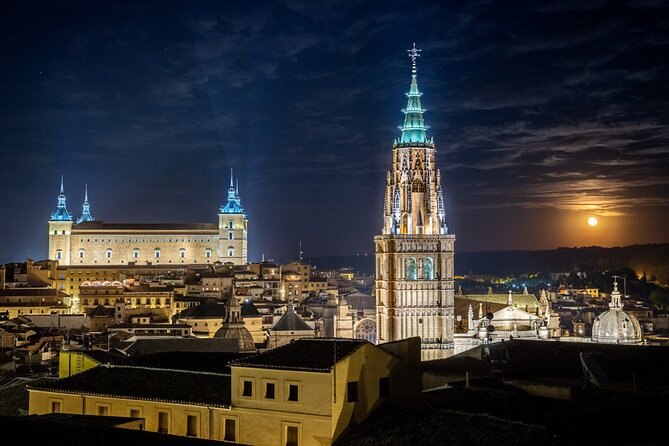
The night walk is at its best then, because the lit stone against a black sky starts at six rather than at ten. If you are staying over between November and February, that is the evening to use.
How does the season change which tour to book?
In summer, take the earliest departure you can and prefer the walks that finish inside a building rather than outside one. In winter, the opposite: the interiors are empty anyway, so a private guide who can move at your pace is worth more than a queue-skipping ticket. And in any season, if you are staying the night, add the two-hour night walk, because that is the one thing the season does not change.
Which format suits you is worked through on which Toledo tour to book, and the month-by-month figures behind all of this are on the weather page.
How far ahead should you book, by season?
The train is the binding constraint, not the tour. Renfe's Avant sells out on summer weekends and around both moveable festivals, and the operators here say so in their own booking notes — one adds that a missed train is not refundable against your tour. Buy the train weeks ahead between May and September and around Easter; a week ahead is enough in January.
The tours themselves fill more slowly. The small-group walks cap at ten and go several days ahead in spring and autumn; the private guides can usually be had at a few days' notice outside the festivals. Free cancellation up to 24 hours before means booking early costs you nothing, which makes the calculation simple.
Does the season change how long you need?
It changes how long you can comfortably spend walking, which amounts to the same thing. In May or October you can be on your feet from ten until six with a lunch break and enjoy all of it. In July or August the usable hours are ten to two and then six until dark, which means a full day becomes two half days with a long gap in the middle.
Plan that gap deliberately rather than discovering it. The Cathedral, the Sephardic Museum and the synagogues are all cool, covered and open through the afternoon, and the Museo Sefardí runs until eight from Tuesday to Saturday. Things to do in Toledo has the afternoon options.
What does each season do to the photographs?
The shot everyone wants is the city from across the gorge, and the season decides both when you can take it and what is in it. In midsummer the light at the Mirador del Valle is usable until well after nine in the evening, and the hill reads as pale gold. In midwinter it is gone by six, and the low sun puts the whole north face in shadow by four.
Inside the walls, autumn and winter are better. The streets are narrow enough that high summer sun leaves half of every alley in hard shadow and the other half blown out, which is why so many good photographs of Toledo are taken in flat light. The Cathedral's rose window is the exception and wants late-morning sun in any month.
What should you wear?
Shoes that cope with cobbles and steps, in every season. Beyond that the seasons ask for different things. From June to September, a hat and more water than you expect, because the hill has no shade and the stone radiates into the evening. From November to February, a layer more than the temperature suggests: the gorge funnels wind round three sides of the city and it is colder on the walls than in the streets.
Shoulders covered at any time of year if you plan to go inside the Cathedral or the churches. They are working religious buildings and the rule is applied.
Which public holidays fill the city?
Three matter. Easter week is the busiest fortnight of the spring and several monuments shift their hours for it. Corpus Christi closes streets along the procession route and fills every bed in the city, on a Thursday that moves with Easter. And the August holidays bring Spanish visitors in numbers, which is a different crowd from the foreign one and concentrates at weekends.
Two national dates also give free museum entry: 12 October and 6 December are free at both the Army Museum and the Sephardic Museum, along with 18 April and 18 May. Those are worth knowing if the budget matters more than the crowd.
The season, in one line each
Spring: the best walking, and two moveable festivals to check. Summer: hot, bright and busy; start at ten and stop at two. Autumn: September is the other perfect month; October is quiet and damp. Winter: cold, empty and excellent for the buildings.
Every departure runs year round, and every fare is compared at Toledo Spain Tours.
Tours that suit the season you are coming in
Private Night Tour on Foot through the Historic Center of Toledo
Two hours after dark, which is the summer answer and the winter one.
From $175 per person
Check AvailabilityToledo Private Tour with Local Guide. Pick up in Madrid optional
Three hours and a quarter at a pace and a start time you choose.
From $161 per person
Check AvailabilityToledo Jewish Heritage Private Tour with expert local guide
Two synagogue interiors, which is where you want to be at two o'clock.
From $147 per person
Check Availability