Facts About Toledo, Spain That Surprise First-Time Visitors
The short answer
Toledo was the capital of Spain until 1561, its cathedral stands on a mosque that stood on a cathedral, its most famous synagogue was built by Muslim craftsmen, and the painter everyone associates with the city was Cretan. Most of what surprises visitors here is a consequence of one of those four things.
It was the capital of Spain, and then it was not
Philip II moved the court to Madrid in 1561, and that single administrative decision is why Toledo looks the way it does. Building stopped. Nothing afterwards was rich enough to knock the old city down and put something else there, so what survives is largely the city of the sixteenth century. Madrid, thirty minutes away, has almost nothing of the same period standing.
The Cathedral is the third religious building on that spot
The Visigoths built a cathedral there. After 711 it became the city's main mosque. After 1085 it became a cathedral again, and the present Gothic building was begun in 1226 and finished in 1493. Three religions, one footprint, in the order the city changed hands — and the pattern repeats across the old town, which is why the history of Toledo is legible on a two-hour walk.
A synagogue built by Muslims for Jews under a Christian king
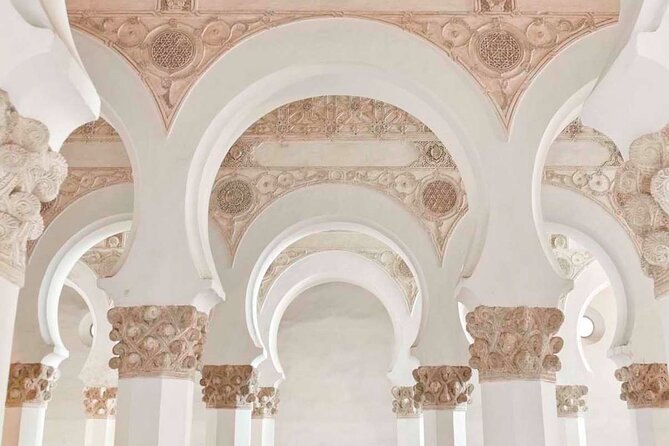
Santa María la Blanca went up around 1180: five naves of white horseshoe arches on octagonal pillars, with carved plaster capitals no two of which are alike. It was commissioned by the Jewish community, built by Muslim craftsmen in the Mudéjar style, in a city ruled by Castile. It is the oldest synagogue building still standing in Europe, and it later served as a church.
El Greco was Greek, and he was thirty-six when he arrived
Doménikos Theotokópoulos was born in Crete, trained in Venice and Rome, and reached Toledo in 1577. He never left. The nickname simply means ‘the Greek’. His work is scattered across the city rather than gathered in a gallery: The Burial of the Count of Orgaz at Santo Tomé, The Disrobing of Christ in the Cathedral sacristy, the View and Plan of Toledo in the Museo del Greco.
🏛 Did you know? The Burial of the Count of Orgaz has hung on the wall it was painted for since 1588. Almost nothing else of that importance in Europe is still in the room it was made for.
Europe learned Aristotle here
Between the twelfth and thirteenth centuries the translators of Toledo turned Arabic and Hebrew works into Latin and Castilian, and in doing so handed medieval Europe much of what it knew of Greek philosophy, medicine, astronomy and mathematics. Aristotle reached Paris and Oxford largely through this city. Alfonso X had the results written in Castilian rather than Latin, which is part of why Castilian became a language of learning.
The escalators are a municipal service
Two mechanical lifts run up into the old town, from the Paseo de Recaredo and the Paseo de Safont, and they are operated by the Ayuntamiento with published opening hours like a bus route. Recaredo runs from 07:00 to 23:00 on weekdays and until 2am on Friday and Saturday nights. It is a strange thing to find in a medieval city and it is the single most useful piece of infrastructure here — the map page has both sets of hours.
Damascening is older than the marzipan, and both are still made
The craft of hammering gold and silver thread into blackened steel has been practised here for centuries, alongside the sword industry it belongs to. It is why every second shop window on Calle Comercio glitters. The marzipan tradition is medieval too, and two of the private walks here stop at a confectioner for a taste of it in passing.
The city is surrounded by water on three sides
The Tagus loops round Toledo to the south, east and west in a gorge a hundred metres deep, leaving only the northern side to defend. That is why the Romans took the hill in 193 BC and why the walls and gates are all on one side. It is also why the famous photograph of the city is taken from outside it.
The city was walled to keep out one side only
You can walk the whole northern wall in half an hour and find nothing comparable on the other three, because the Tagus did that job. The Puerta de Bisagra and the Puerta del Sol are on the flat approach; everywhere else the ground simply falls away. It is the reason the Romans wanted the hill and the reason the city never spread.
It also explains something you will notice as you walk: the old town has no ring road, no boulevard and almost no straight line. There was never anywhere to put one. The map page shows the shape it left behind.
Nine facts, in one table
| Fact | The figure |
|---|---|
| World Heritage inscription | 1986, criteria (i)(ii)(iii)(iv) |
| Roman municipium | 193 BC |
| Visigothic capital | From about 542 |
| Taken by Alfonso VI | 1085, under terms |
| Mosque of Cristo de la Luz built | 999 |
| Cathedral built | 1226–1493 |
| El Greco arrives | 1577, aged 36 |
| Court leaves for Madrid | 1561 |
| Alcázar besieged and destroyed | 1936, over seventy days |
The Alcázar you see is not the one that was besieged
The Alcázar was reduced largely to rubble in a seventy-day siege in 1936 and rebuilt afterwards. So the square block with a tower at each corner is a twentieth-century reconstruction of a sixteenth-century building standing on a Roman and Muslim site. It now holds the Spanish army's national museum.
If you want to go inside it, plan your visit for a Wednesday, when admission is free, and not for a Monday, when it is shut. None of the guided tours listed here goes in, so this is one you do on your own time — things to do in Toledo has the rest of what you can add to a day yourself.
The city's own festival moves every year
Corpus Christi is Toledo's largest festival and a Fiesta of International Tourist Interest. Enrique de Arfe's silver monstrance is carried out of the Cathedral through streets roofed with awnings and hung with tapestries. It falls on a Thursday whose date moves with Easter, so check the city's own programme before you book anything around it.
- The monstrance took Arfe seven years to make.
- It encloses an earlier Gothic ostensorio said to use 17 kg of the first gold brought from America.
- The streets on the route are covered with cream awnings for the week.
Which of these you can actually see in a day
Most of them, and that is the surprising part. You can stand in the synagogue built by Muslim craftsmen, walk into the cathedral that replaced a mosque, look at the El Greco on the wall he painted it for and ride a municipal escalator back down — all inside three hours and about €30 of admissions.
What you cannot do in a day is understand any of it from the buildings alone, which is why the guiding here is worth what it costs. If you would rather have it explained as you walk, compare guided tours of Toledo, and read the key highlights for what each building actually holds before you choose which doors to pay for.
Walks that go into the detail
Essence of Toledo: Private Tour with a Local Archaeologist
An archaeologist, the Roman baths and a twelfth-century well under the city.
From $236 per group, up to 15
Check AvailabilityToledo Jewish Heritage Private Tour with expert local guide
Both surviving synagogues and the Sephardic Museum, read by a specialist.
From $147 per person
Check AvailabilityToledo Historical Small Group Tour with Cathedral & Monuments
Four buildings in four hours, with three of the tickets already bought.
From $76 per person
Check Availability